The Most Common Types of Agricultural Fertilizers
Fertilizers generally fall into four commercial categories:
1. Chemical (Inorganic) Fertilizers
These are synthetic or mined mineral salts designed for fast nutrient release and high elemental concentration.
-
Nitrogen (N) Sources: Urea, ammonium nitrate, and ammonium sulfate. High in nitrogen, but naturally prone to drawing moisture out of the air.
-
Phosphorus (P) Sources: Monoammonium phosphate (MAP), diammonium phosphate (DAP), and single superphosphate (SSP). These supply root-building phosphorus and provide structural integrity to granule blends.
-
Potassium (K) Sources: Potassium chloride (Muriate of Potash or MOP) and potassium sulfate (SOP).
-
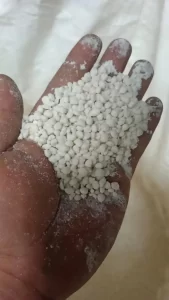
NPK Compounds: Homogeneous compounds containing balanced proportions of two or three primary macronutrients (e.g., 15-15-15, 17-17-17, or 20-10-10).
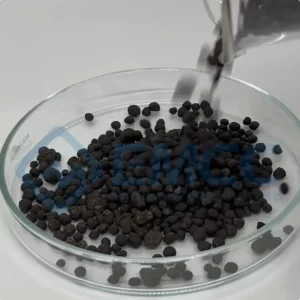
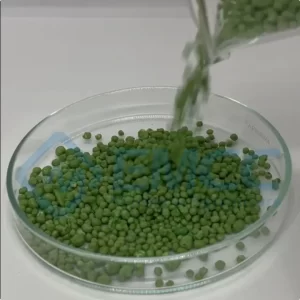
2. Organic and Bio-Organic Fertilizers
Derived from natural biological waste streams, these fertilizers improve long-term soil structure, moisture retention, and beneficial microbial life.
-
Composted Manures: Chicken litter, cow manure, and swine slurry cake, etc.
-
Plant Residues: Biochar, crop straw ash, spent mushroom compost, and press mud from sugar refining, etc.
-
Bio-Organic Formulations: Organic bases inoculated with living bacterial strains (like Bacillus subtilis or mycorrhizal fungi) that unlock bound minerals in the soil.
3. Organo-Inorganic Compound Fertilizers
These bridge the gap between fast-acting synthetic chemicals and slow-release organic materials, combining chemical salts (urea, MAP, potassium sulfate) with fermented organic bases (humic acid, amino acids, or composted manure).
-
The Agronomic Advantage: Inorganic ions provide immediate crop nourishment, while the organic matrix chelates micronutrients, buffers soil acidity, reduces nutrient leaching, and feeds root-zone microorganisms.
4. Bulk Blended (BB) Fertilizers
Instead of chemically synthesizing every nutrient into a single pellet, BB fertilizers are made by physically dry-mixing pre-granulated components (e.g., blending pure urea prills, DAP granules, and potassium chloride crystals).
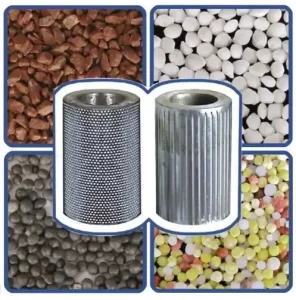
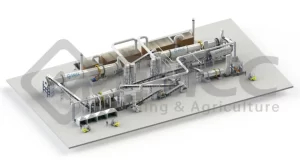
Essential Fertilizer Production Equipment
Transforming raw powders, composts, and chemical slurries into hard, uniform pellets involves a sequence of specialized unit operations.
Raw Material (Crushers / Mixers) ──► Granulation (Core) (Drum / Roller / Disc) ──► Drying & Cooling (Rotary Dryer & Rotary Cooler) ──► Screening & Coating (Screens / Coating Machine)
1. Size Reduction & Mixing Machinery
Granulation requires fine, consistent feedstock. Large lumps ruin granule quality.
-
Cage Mills & Semi-Wet Material Pulverizers: Semi-wet hammer crushers process sticky compost with 20%–40% moisture without blinding the screen, while cage mills crush hard crystalline salts down to fine powder.
-
Horizontal Double-Shaft Mixers: Interlocking paddles thoroughly homogenize dry powders, humic acids, and liquid binders into an even matrix before granulation.
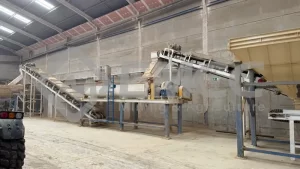
2. Core Granulation Equipment
The granulator is the heart of the production line:
-
Rotary Drum Granulators: The primary choice for high-volume chemical NPK and commercial-scale organo-inorganic lines (10 to 30+ tons per hour). Powder enters a slightly inclined, rotating steel cylinder lined with flexible rubber sheets. Liquid sprays or steam create a rolling bed where particles tumble together into dense, spherical granules.
-
Double Roller Extrusion (Compactor) Granulators: The go-to solution for dry granulation. Material feeds between two counter-rotating rollers with matching exterior molds. Under extreme hydraulic pressure, dry powders are squeezed into hard cakes or briquettes, then fractured into granular shapes. No water is added, meaning no rotary dryers are needed.
-
Disc (Pan) Granulators: An inclined circular pan spinning at an angle between 45 ° and 55 °. Liquid sprays onto the powder, and centrifugal force naturally rolls the feed into smooth, spherical balls. Widely used for small-to-medium organic fertilizer setups (1 to5 tons per hour).
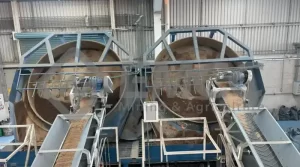
3. Drying and Cooling Systems
Granules made through wet granulation (rotary drums and discs) contain 10% to 35% moisture and require moisture removal to avoid collapse.
-
Rotary Dryers: Large rotating cylinders with interior lifters that lift and shower wet granules through a hot air stream (fueled by natural gas, oil, biomass, or coal), driving moisture down below targeted thresholds.
-
Rotary Coolers: Directly follow the dryer, drawing ambient air across the warm granules to drop their temperature below 40 ℃. Packing hot fertilizer inside plastic sacks creates condensation, leading directly to caked product.
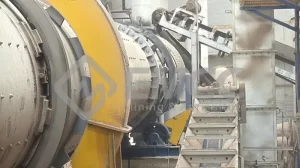
4. Screening, Recycling, and Coating Machines
-
Rotary Drum or Vibrating Screens: Sift the cooled granules. Oversized granules go to a chain crusher to be ground down; undersized fines route back to the granulator inlet. Only on-spec product (like 2.0 to 4.75 mm) passes through.
-
Rotary Coating Drums: Spray a light mist of amine-based anti-caking oil and/ or micro-fine talc or clay powder. This seals the granule against ambient humidity so it will not turn into a solid block during warehouse storage.
Matching Machine to Fertilizer Type
| Fertilizer Category | Typical Raw Materials | Ideal Granulation Equipment | Thermal Drying Needed? |
| High-Volume NPK | Urea, MAP, DAP, Potash, Slurries | Rotary Drum Granulator | Yes (Rotary Dryer + Cooler) |
| Heat-Sensitive Chemicals | Ammonium sulfate, pure salts | Double Roller Compactor | No (Direct dry packaging) |
| Small-Scale Organic | Composted chicken manure, humic acid | Disc (Pan) Granulator | Yes (Low-temp drying) |
| Bulk Blends (BB) | Pre-formed dry granules | Rotary Mixer | No (Mechanical blend only) |