
When designing a fertilizer production line or upgrading your manufacturing facility, choosing the right granulation machine is a critical decision that directly impacts your product quality and bottom-line profitability. The choice between a disc granulator (also known as a pan granulator) and a rotary drum granulator ultimately comes down to a comprehensive analysis of three core dimensions: production capacity, raw material characteristics, and investment budget.
In short, the industry rule of thumb is: “Choose the disc granulator for flexibility; utilize the rotary drum granulator for high efficiency.”
To provide a clear and intuitive comparison, the engineering and technical team at EMCC has compiled the following comprehensive comparison table:
| Comparison Dimension | Disc Granulator (Pan Granulator) | Rotary Drum Granulator |
| Target Scale | Small-scale, highly flexible production lines.
Ideal for annual capacities ≤ 50,000 tons. |
Large-scale, continuous, and heavy-duty operations.
Ideal for annual capacities ≥ 100,000 tons. |
| Single-Machine Capacity | 0.5-8 tons/ hour. | 5-50 tons/hour, or even higher. |
| Equipment Investment (CAPEX) | Lower initial cost. Simple structure; initial investment starts around tens of thousands of USD. | Higher initial cost. Requires supportive large-scale infrastructure; investment starts around USD100,000. |
| Operating Cost (OPEX) | Lower energy consumption per machine (saves 15%–25% compared to drum granulators). | Higher overall energy consumption, though unit energy consumption drops significantly at large-scale capacity. |
| Material Adaptability | Excellent for high-moisture and high-viscosity materials (e.g., fermented organic fertilizer, wet sludge, livestock/poultry manure). | Wide range of materials; particularly ideal for low-moisture feedstocks (e.g., compound fertilizer, mineral powders, dry materials). |
| Finished Granule Quality | Spherical and well-rounded pellets, but with lower mechanical strength. Perfect for localized sales and gardening applications. | Diverse shapes available with high mechanical strength. Ideal for bulk long-distance transportation and large-scale agricultural application. |
| Operation & Maintenance | Simple, intuitive operation; straightforward and convenient maintenance routines. (Professional personnel are needed for monitoring and maintenance) | High level of automation but relatively complex. Requires trained personnel for monitoring and maintenance. (Operators can take up their posts after simple training) |
| Production Flexibility | Exceptionally high. Quick adjustment of formulas and processing parameters. | Lower flexibility. Suitable for long-term, continuous runs of fixed product formulas. |
| Environmental Control | Open-type system; dust and odor emissions are more challenging to contain. | Enclosed system; easy to integrate with dust collection and odor control infrastructure. |
Deep-Dive Process Characteristics & Technical Insights
Beyond the intuitive comparisons, EMCC highlights three critical, deep-level process characteristics that engineering teams must evaluate during the project planning phase:
1. Material Return Rate and Processing Efficiency
- Disc Granulator:Features a low material return rate (10%–15%) and a high granulation rate (can up to 95%+). As most materials are formed into shape in a single pass without large-scale recycling, downstream drying processes operate at maximum efficiency, lowering overall energy consumption.
- Rotary Drum Granulator:Typically exhibits a higher material return rate (often exceeding 30%). However, this high volume of returned material acts as a process “buffer”—when the properties of the raw material fluctuate, the recycling system allows the entire line to stabilize much faster.
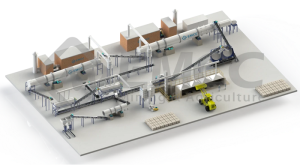
EMCC Technical Note: EMCC provides professionally engineered material return and recycling systems for both disc and rotary drum granulation lines, ensuring optimal raw material utilization and minimal waste.
2. Particle Size Control and Product Customization
- Disc Granulator:Offers exceptional natural particle classification during rotation. It allows operators to precisely control the granule size within a narrow distribution range, making it highly suitable for specialty products requiring tight sizing tolerances.
- Rotary Drum Granulator:Provides less inherent control over exact particle sizing, resulting in a wider distribution of granule sizes. Consequently, these systems must be equipped with industrial screening equipment to separate over-sized and under-sized granules and route them back into the system as return material.
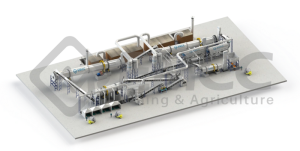
EMCC Technical Note: All EMCC customized granulation production lines feature advanced, multi-stage screening systems designed for precise final particle size classification and premium product aesthetics.
3. Footprint and Spatial Requirements
- Disc Granulator:Features a compact horizontal footprint (approximately 3–5 square meters per unit) but stands relatively tall, requiring sufficient vertical clearance within the factory building.
- Rotary Drum Granulator:Demands a significantly larger horizontal footprint (approximately 10–20 square meters per unit) due to its horizontal, inclined layout. It places higher demands on horizontal floor space rather than vertical height.
Final Selection Guide & Expert Recommendations
To streamline your decision-making process, EMCC recommends aligning your equipment choice with your specific business model and operational parameters:
Choose the “Disc Granulator” if you meet the following criteria:
- Small-to-Medium Scale:You are a startup or local processor with a daily output ranging from a few tons to dozens of tons.
- High-Moisture/Sticky Raw Materials:Your feedstocks have high moisture content and high natural viscosity, such as fresh poultry or cattle manure.
- Limited Initial Capital:You want to launch your project quickly with a lower initial capital expenditure (CAPEX).
- Agile Production Needs:Your business model requires frequent adjustments to fertilizer formulas, or you serve a premium market that demands exceptionally round granules.
Choose the “Rotary Drum Granulator” if you meet the following criteria:
- Industrial-Scale Operations:Your target annual production capacity spans tens of thousands or hundreds of thousands of tons.
- Dry/Powdered Raw Materials:You process well-blended, relatively dry powder formulations, such as NPK compound fertilizers.
- High Granule Durability Requirements:Your products must withstand long-distance shipping, bulk handling, and mechanical blending without breaking down into dust.
- Long-Term Strategic Outlook:You are focusing on continuous, 24/7 uninterrupted, and highly automated mass production.
If you have specific raw material specifications, a targeted hourly output, or a strict budget framework, please contact the EMCC technical support team. Our senior application engineers will provide a detailed, data-driven custom technical proposal tailored to your project.