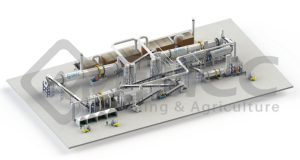
Operating on the principle of continuous wet rolling agglomeration, a rotary drum granulator converts fine raw powders and liquid binders into dense, high-strength, uniform spherical pellets.
Here is an in-depth breakdown of why top industrial fertilizer producers choose rotary drum granulators and what key process benefits they deliver.
Key Reasons to Choose a Rotary Drum Granulator
1. High Single-Line Production Capacity
The most prominent advantage of a rotary drum granulator is its massive processing capability. Unlike disc granulators or roller compactors—which typically top out at 1 to 10 tons per hour per unit—a industrial rotary drum can process 10 to 30+ tons per hour on a single line (yielding over 30,000 to 200,000 tons per year).
-
Industrial Value: Allows large commercial fertilizer plants to maximize economies of scale with fewer parallel lines, reducing overall plant footings and equipment footprint.
2. Exceptional Granule Hardness and Crushing Strength
Compound fertilizers (such as NPK 15-15-15, 17-17-17, or 20-10-10) must endure extensive handling, bulk storage, and long-distance ocean transport without crushing into dust.
-
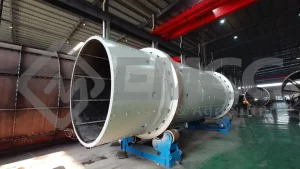
How It Works: Inside the inclined rotating drum, material undergoes a continuous tumbling, rolling, and polishing action. Combined with steam injection or liquid binders, this high bed pressure drives air out of the pellets, producing dense granules with a static crushing strength typically exceeding 15 to 25 N per granule.
3. Flexible Chemical Formulation & Liquid-Phase Granulation
Rotary drum granulators excel at handling complex chemical formulations that require liquid injection.
-
Chemical Compatibility: They are ideal for steam granulation, acid-base ammoniation systems, and liquid slurries (such as urea melt, ammonium nitrate, or phosphoric acid slurries).
-
Process Adaptability: Operating bed temperatures can be safely raised to 65°C – 85°C via steam injection, increasing salt solubility in the liquid phase and reducing the amount of added water that needs to be evaporated downstream.
4. Heavy-Duty Durability & Long Equipment Service Life
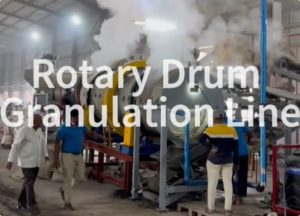
Built with heavy-gauge carbon steel or corrosion-resistant stainless steel shells, rotary drum granulators feature robust girth gear drives, heavy-duty riding rings, and high-density rubber liners to prevent internal material caking and wall corrosion.
-
Service Life: With routine lubrication and care, a industrial drum granulator easily achieves an operational lifespan of 15 to 20+ years.
Summary: When Should You Choose a Drum Granulator?
-
Choose a Rotary Drum Granulator if: You are building a high-capacity commercial fertilizer plant (>30,000tons/year), require high granule crushing strength for long-distance export, or process NPK formulations using steam, slurry, or melt injection.
-
Consider Alternatives if: You operate a small facility (<10,000tons/year) with low capital expenditure (where a Disc Granulator is preferred), or need to eliminate thermal drying fuel costs completely (where a Double Roller Compactor is preferred).