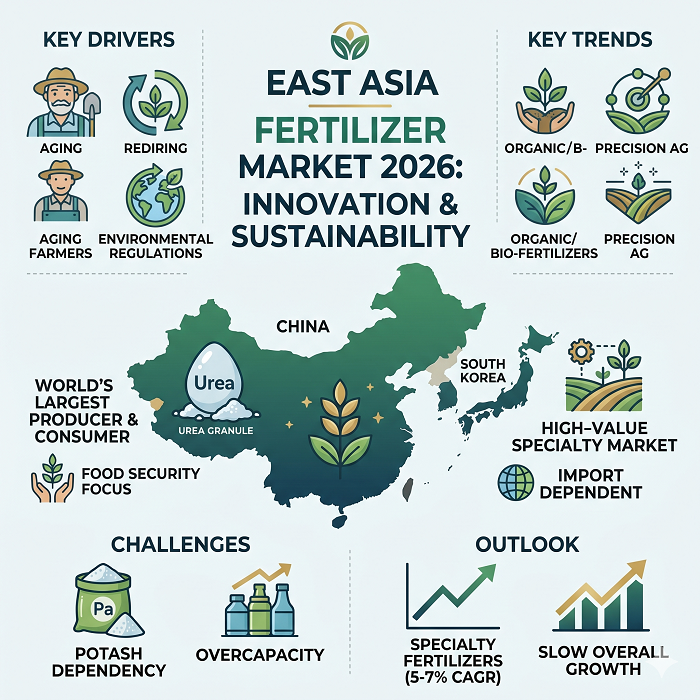
East Asia is the largest fertilizer production and consumption hub in the world, dominated by China. While China focuses on volume and self-sufficiency, Japan and South Korea represent mature, high-value markets for premium and specialty fertilizers.
Market Status
China: World’s largest producer and consumer of nitrogen and phosphate fertilizers. China’s Share:>30% of Asia-Pacific consumption
Japan & South Korea: Highly dependent on imports (especially potash and phosphate); demand is for high-efficiency, controlled-release, and environmentally friendly products.
Key Drivers
Food security policies in China (self-sufficiency in grains).
Aging farming population driving demand for labor-saving, high-efficiency fertilizers.
Environmental regulations pushing for reduced chemical fertilizer use (China’s “zero-growth” policy).

Key Trends
| Trend | Impact |
| Shift to organic & bio-fertilizers | Replacing synthetic fertilizers, supported by subsidies |
| Precision agriculture & water-soluble fertilizers | Growing demand in Japan and South Korea |
| Consolidation of domestic fertilizer producers | China closing small, inefficient plants |
Challenges
Overcapacity in China’s nitrogen and phosphate sectors leading to low margins.
High raw material import dependency for potash (China imports >50% of its potash).
Aging rural workforce requiring simpler, more efficient fertilizer solutions.
Outlook (2026-2030)
| Aspect | Projection |
| Overall Market Growth | Slow (1-2% annually) |
| Specialty Fertilizers | Fastest-growing segment (5-7% CAGR) |
| Imports | Potash imports to remain stable; urea exports to decline |
Strategic Implication: Focus on high-efficiency, controlled-release, and bio-based fertilizers for Japan/South Korea, and explore organic fertilizer technology opportunities in China.