
Then there’s the shell left behind. Once the nutrient is gone, what happens to the coating?
Most CRFs use petroleum-based films, polyethylene, polyurethane, acrylic resins. They give a predictable release curve, but they don’t break down in soil. Keep using them year after year and the empty shells fragment into microplastics that stay in the field. That’s what’s driving the work on bio-based, biodegradable coatings.
The catch is physical. A film dense and water-repellent enough to meter nutrients for 180 days is also hard for microbes to digest. Make it biodegradable and you tend to lose the release control that made the granule worth coating in the first place.
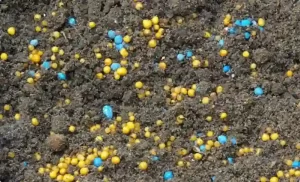
What controls release inside a coated granule
Release comes down to water vapor diffusion and osmotic pressure across a thin membrane, usually 20 to 100 µm thick, about the width of a human hair.
Coat thickness sets the duration. Take a polyurethane coating from 3% to 6% of granule weight and a 60-day product becomes a 120- or 180-day one.
Pore structure sets the shape of the release curve. Synthetic resins are good at this because their micro-pores are uniform, giving the “S-shaped” pattern growers expect: a short lag after planting, steady release through peak growth, then a taper toward maturity. If the film cracks in handling or swells too quickly in wet soil, the granule dumps its nitrogen early and can burn roots. That defeats the point of controlling release at all.
The microplastic question in intensive farming
Polymer-coated fertilizers earned their reputation by cutting nitrous oxide emissions and nitrate runoff. Soil sampling in intensively farmed regions has since turned up a side effect nobody was measuring: shell fragments building up in topsoil after harvest, ground down by tillage and freeze-thaw cycles into particles under 5 mm.
The fragments are there. What they actually do is less clear. The usual concerns are soil pore clogging, changed water retention, and ingestion by soil organisms, but most field work shows exposure rather than confirmed harm at normal application rates. The risk accumulates over years, so regulators are moving before the toxicology is settled. The EU’s fertilizing products rules are the clearest example, with tight biodegradability thresholds.
An arable farm that has put polymer-coated urea on the same ground for ten years will find shell fragments in the topsoil after harvest. Nobody was looking for that residue a generation ago. Now soil samples are taken specifically to find it.
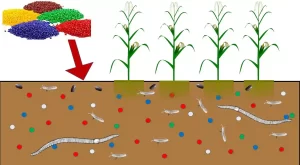
Bio-based and biodegradable coatings
Researchers and equipment makers are rebuilding the coating layer from materials that break down into carbon dioxide, water, and microbial biomass after harvest.
Two problems have to be solved before this works at scale.
First, water absorption. Starch and cellulose soak it up, so early bio-coatings swelled and burst within days. Newer formulations cross-link plant oils, castor or soybean, with bio-based isocyanates or lignin. The result is a water-repellent barrier much like petroleum polyurethane, but it doesn’t leave permanent plastic behind.
Second, applying the stuff. Bio-based resins are viscous, so rotary coating drums and fluidized-bed coaters need tighter temperature and spray control to lay down a film just 30-60 µm thick over every granule without clumping.
What this means for producers and growers
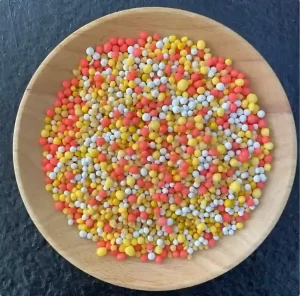
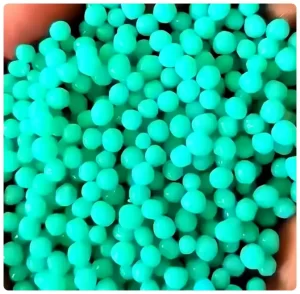
A coated granule is a small piece of engineering: the film’s chemistry, measured in microns, decides both how much crop you get and what’s left in the soil. How quickly producers switch comes down to two things. One is cost, since bio-based polyols and PHA still carry a premium over petroleum resins. The other is timing: the coating has to hold through the whole crop cycle, then break down once the harvest is in.
As bio-based coatings scale and get cheaper, and as coaters learn to handle them with the same precision as conventional resins, the gap between release control and degradability should get smaller. That’s the goal anyway: same nutrient efficiency, less residue, at a price growers can actually pay.