
Choosing the right compound fertilizer granulator is one of the most critical decisions when designing or upgrading a fertilizer manufacturing line. Compound fertilizers (such as NPK 15-15-15 or NPK 17-17-17) require specific physical density, moisture control, and particle strength to remain free-flowing during transport and application.
The three primary types of granulators dominating the compound fertilizer industry are:
- Rotary Drum Granulator
- Double Roller Granulator (Roller Compactor)
- Disc Granulator (Pan Granulator)
Each machine relies on distinct scientific principles—ranging from wet agglomeration to dry mechanical compaction. Here is an objective comparison of how they work, their performance profiles, and which machine is best suited for your specific production goals.
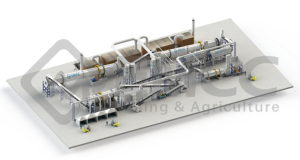
The Contenders: How They Work
1. Rotary Drum Granulator (Best for Large-Scale Wet Granulation)
Principle: Wet rolling agglomeration. Raw fertilizer powders are fed into an inclined rotating drum. Steam, liquid binders, or chemical slurries are sprayed onto the tumbling bed of material, causing fine particles to stick together and roll into spherical granules.
Key Feature: Designed for continuous, heavy-duty production lines yielding 10 to 30+ tons per hour per drum.
2. Double Roller Granulator (Best for Dry Compaction & Low Energy)
Principle: Dry mechanical compaction. Dry fertilizer powders are fed between two counter-rotating rollers under high hydraulic pressure. Air is squeezed out, forcing the material into dense sheets or briquettes, which are then crushed into granules.
Key Feature: Zero liquid or drying required. Operates at ambient temperature without water or steam.
3. Disc Granulator / Pan Granulator (Best for Flexible, Small-to-Mid Scale Production)
Principle: Centrifugal wet agglomeration. Powder feeds onto an inclined rotating disc while a fine mist of binder is sprayed over the bed. Centrifugal force, gravity, and surface tension roll the material into smooth, highly spherical pellets.
Key Feature: High on-size yield (88%–93%+) with an open-pan design for real-time visual control.
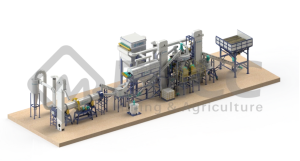
Head-to-Head Performance Comparison
| Feature / Metric | Rotary Drum Granulator | Double Roller Granulator | Disc (Pan) Granulator |
| Granulation Method | Wet (Steam/Water/Slurry) | Dry (Pressure Compaction) | Wet (Liquid Binder Spray) |
| Moisture Required | Moderate (8% – 15%) | Low (< 3%) | Moderate (12% – 20%) |
| Drying System Needed? | ✅ Required | ❌ Not Needed | ✅ Required |
| Granule Appearance | Smooth & Spherical | Irregular / Angular / Pillow | Highly Spherical & Polished |
| Production Scale | High (10 – 30+ t/h) | Low-Mid (1 – 10 t/h) | Low-Mid (1 – 10 t/h) |
| Energy Usage (CAPEX/OPEX) | High CAPEX / High Drying OPEX | Low CAPEX / Low Energy OPEX | Low CAPEX / High Drying OPEX |
| Best Raw Material Blend | Urea, Ammonium Sulfate, NPK | Heat/Moisture-Sensitive Salts | Organic-Inorganic Blends, NPK |
Pros & Cons Breakdown
Rotary Drum Granulator
Pros: Unmatched single-unit output capacity; excellent granule hardness and crushing strength; ideal for adding chemical slurries or steam.
Cons: High initial equipment cost (CAPEX); requires downstream rotary dryers and coolers (raising fuel costs).
Double Roller Granulator
Pros: Highly energy-efficient (cuts drying fuel costs); perfect for heat-sensitive or water-soluble chemical formulations; compact plant footprint.
Cons: Lower unit throughput; granules are less spherical with an angular appearance; higher mechanical roller wear over time.
Disc Granulator
Pros:Highly affordable upfront investment; exceptional pellet roundness and aesthetic market appeal; minimal material recycling load.
Cons: Requires a rotary dryer downstream; open-pan design generates dust if unhooded; moderate capacity per unit.
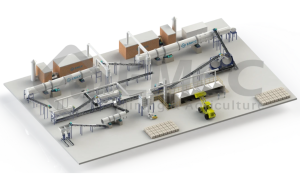
The Final Verdict: Which Granulator Is Better for You?
The answer depends on your production capacity, budget, and raw material sensitivity:
Choose a Rotary Drum Granulator if: You are building a commercial-scale compound fertilizer plant producing over 30,000 to 100,000+ tons per year, and you require high-strength, uniform NPK granules.
Choose a Double Roller Granulator if: You want to eliminate thermal drying costs, have limited floor space, or process heat-sensitive raw materials like pure urea or ammonium chloride blends.
Choose a Disc Granulator if: You are starting a small-to-medium facility (1,000 to 20,000 tons/year) where low upfront equipment cost and perfectly round, attractive granules are top priorities.