
1. The Science: Why Fertilizer Cakes
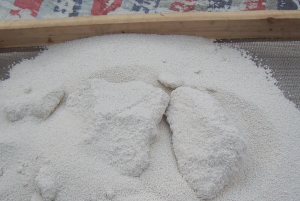
Caking is driven by hygroscopic moisture absorption, surface salt dissolution, and crystal bridging.
-
Moisture Absorption: Fertilizer salts absorb air moisture when ambient humidity exceeds their Critical Relative Humidity (CRH). Blending ingredients (like Urea and MAP) severely depresses overall CRH, making NPK blends highly moisture-sensitive.
-
Surface Dissolution: Absorbed water dissolves surface salts into a saturated liquid film.
-
Crystal Bridging: Shifts in storage temperature or humidity evaporate water from the film. Dissolved salts recrystallize between contact points, forming rigid “salt bridges” that bind granules together under warehouse stack pressure.
-
2. Upstream Process Control (70% of Defense)
Effective caking prevention starts inside the production line before applying anti-caking agents.
-
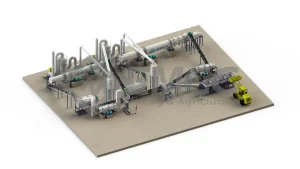
Strict Moisture Reduction: Residual internal water fuels crystal bridging. Use two-stage rotary drying (Primary + Secondary) to drive product moisture down to minimal target levels.
-
Complete Product Cooling: Packaging warm fertilizer creates thermal gradients inside sealed bags. Water vapor evaporates from warm core granules and condenses on cooler outer bag walls (re-moistening). Pass granules through a rotary cooler until product temperature drops near ambient.
-
Granule Strength & Sizing: Fragile granules crush under stack weight, generating fines that fill voids and accelerate caking. Maintain optimal liquid-phase ratios during granulation to build high static crushing strength and ensure uniform particle sizing.
3. Surface Conditioning: Dual Coating System
Applying a protective surface treatment inside a rotary coating drum provides vital secondary defense:
-
Hydrophobic Coating Oil: Fine mist of amine-modified paraffinic oil forms a water-repellent micro-film over granule faces, blocking moisture uptake and salt dissolution.
-
Inert Anti-Caking Powder: Micro-fine talc or kaolin powder adheres to the oil film, serving as physical spacers to prevent direct salt-to-salt contact between neighboring granules.
4. Quick Troubleshooting Guide
| Issue Observed | Primary Cause | Actionable Solution |
| Hard blocks at stack bottoms | High residual moisture or weak granules | Boost dryer heating efficiency; optimize binder ratios to increase granule hardness. |
| Caking near bag seams | Product bagged while still warm | Increase rotary cooler airflow to lower product temperature near-ambient before packing. |
| Uniform soft caking in pile | High storage humidity or uneven oil coating | Clean spray nozzles; ensure fine oil atomization; check warehouse humidity controls. |
Summary
Keep drum-granulated NPK fertilizers free-flowing through an integrated four-part strategy: deep drying to eliminate internal moisture, thorough cooling to stop in-bag moisture migration, strong granule hardness to prevent crushing under stack weight, and dual oil-powder coating to seal particle surfaces.