
In fertilizer production, chemical processing, and mineral processing, a low balling rate (or low granulation efficiency) on a disc pelletizer (pan granulator) can cause severe production bottlenecks. When the machine yields too many “unders” (excessive dust/fines) or “overs” (oversized lumps), raw material waste escalates, and energy costs rise due to high recirculation rates.
Achieving an optimal disc granulator balling rate (90%+ on-size yield) requires balancing physical forces: gravity, centrifugal force, friction, and liquid surface tension.
Here is a step-by-step troubleshooting guide to diagnose low balling efficiency and get your disc pelletizer back to peak performance.
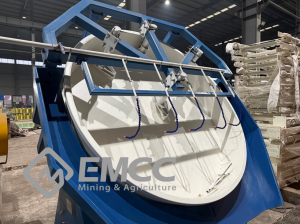
1. Adjust Operating Mechanical Parameters
The trajectory of the powder rolling on the pan face dictates granule formation. If the tumbling action is disrupted, material will slide instead of roll, preventing seed pellets from forming.
Disc Rotation Speed (RPM):
The Issue: If the RPM is too low, kinetic energy is insufficient, causing powder to slide at the bottom of the disc rather than lift and roll. If the RPM is too high, centrifugal force pins material to the rim, stopping the cascading motion.
The Fix: Fine-tune your Variable Frequency Drive (VFD). Adjust the speed until the powder reaches the 10 o’clock to 11 o’clock position (for clockwise rotation) before cascading down smoothly.
Disc Inclination Angle:
The Issue: A pan angle that is too steep reduces retention time, causing unformed fines to spill over the rim prematurely. An angle that is too flat leads to over-granulation and oversized lumps.
The Fix: The standard inclination angle ranges between 40° and 55°. Steeper angles produce smaller granules; flatter angles produce larger ones. Adjust by 1°–2° increments while monitoring output.
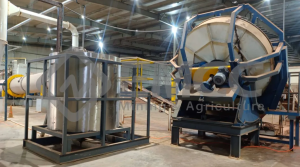
2. Optimize Liquid Binder & Spray System
Liquid surface tension acts as the “glue” that forms seed pellets. Improper binder application is a primary culprit behind low balling rates.
| Symptom | Root Cause | Actionable Solution |
| Excessive Fines / Dust | Binder volume is too low, or mist is too coarse. | Increase binder flow rate slightly or switch to fine-atomization spray nozzles. |
| Large Muddy Lumps | Excess moisture or heavy liquid drop impact. | Move spray zone further up the pan face and reduce droplet size. |
| Weak, Fragile Pellets | Incorrect binder concentration or low viscosity. | Increase binder concentration (e.g., starch, molasses, lignosulfonate) by 0.5%–1%. |
Spray Nozzle Placement: Ensure nozzles target the feed zone (where dry powder enters) to initiate micro-agglomerates. Do not spray directly onto the discharge rim.
3. Check Raw Material Properties
Even with perfect machine settings, poor feedstock quality will drag down the balling rate.
Particle Size Distribution (PSD):
Rule o Thumb: Fine powder granulates best. Ideally, raw powder should be under 80 mesh.
If raw particles are too coarse, they lack the capillary force needed for liquid bridging. Run coarse feedstock through a chain crusher or pulverized grinder before feeding the disc.
Pre-Moisture Uniformity:
Raw material with erratic moisture swings causes chaotic growth patterns on the pan face.
Solution: Install a mixer upstream. Pre-conditioning raw powder with a small amount of liquid binder ahead of the disc pelletizer creates uniform “seed pellets” and drastically speeds up pan balling rates.
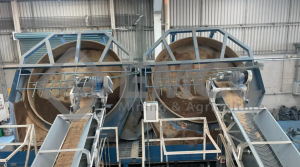
4. Inspect Scraper Condition & Buildup
A neglected pan lining disrupts the smooth surface needed for consistent rolling.
Worn Scraper Blades: Scrapers maintain a smooth, uniform bed of material across the pan bottom. Worn or misaligned scrapers allow uneven buildup to accumulate.
Uneven Friction: Irregular material buildup creates dead zones where pellets get trapped or crushed. Clean the scraper assembly weekly and maintain an offset gap of approximately 3–5 mm from the pan face.
Quick Diagnostic
Low Balling Rate Detected
Step 1: Check Moisture (Optimal wet-granulation moisture: 15%–35%)
Step 2: Check Granule Trajectory (Does material cascade smoothly at 10-11 o’clock?)
Step 3: Inspect Spray Pattern (Are nozzles clogged or dropping large droplets?)
Step 4: Verify Feed Fineness (Is feedstock ground finer than 80 mesh?)
By systematically optimizing speed, tilt, spray atomization, and pre-mixing, disc pelletizer balling rates can consistently reach 90% to 95% on-size yield, reducing recycle loads and maximizing line efficiency.