
The North American fertilizer industry in 2026 is navigating a complex landscape defined by high market volatility, a massive shift toward “Green Ammonia,” and the rapid adoption of precision agriculture.
Market Overview & Financials
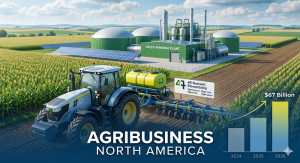
The North American fertilizer market is valued at approximately $67 billion in 2026. While the market is growing at a steady 5.1% CAGR, it remains “tight” due to geopolitical disruptions (notably impacts from the conflict in Iran) and escalating nitrogen prices.
Dominant Players: The market is led by a few major Canadian potash producers and large-scale U.S. nitrogen and phosphate conglomerates. These entities control the majority of the domestic supply chain and export logistics.
Segment Trends: Nitrogen remains the largest segment by volume, driven by massive corn and soybean acreage in the U.S. Midwest, which is projected to reach over 96 million acres this year.
The Rise of “Green” & Low-Carbon Ammonia
2026 is a breakout year for sustainable nutrients. North America is positioning itself as a global hub for green fertilizer production to meet decarbonization goals.
U.S. Green Ammonia Market: Currently valued at $1.64 billion, this sector is projected to grow exponentially as major industrial gas and chemical firms scale up domestic electrolysis facilities.
On-Farm Production: A major trend is Distributed Green Ammonia (DGA)—modular systems that allow large farms or regional agricultural cooperatives to produce their own nitrogen using renewable energy, reducing reliance on global supply chains.
Incentives: Growth is heavily fueled by the U.S. Inflation Reduction Act (IRA) and Canadian carbon-reduction subsidies, making domestic green production more competitive against traditional imports.

Precision Agriculture & Specialty Fertilizers
To combat rising costs and environmental regulations, North American farmers are shifting from “bulk” to “smart” application.
Specialty Fertilizers: Growth in controlled-release granules and water-soluble fertilizers is outpacing traditional formats. These are essential for high-value crops in California and Florida.
Fertigation: The integration of fertilizer into irrigation systems is expanding at nearly 6% annually, significantly reducing nutrient runoff.
Biologicals: There is an increased use of microbial-based fertilizers and bio-stimulants as farmers seek to improve soil health and reduce synthetic input requirements.
Key Challenges
Price Squeezes: Rising energy costs in early 2026 have spiked retail prices for potash and nitrogen, severely tightening farm margins.
Logistics: The industry continues to face aging rail and barge infrastructure, making the transport of bulk fertilizers from the Gulf Coast to the Midwest a recurring bottleneck.
Regulation: Stricter EPA and Canadian environmental mandates regarding nutrient runoff are forcing a mandatory shift toward “4R Nutrient Stewardship” (Right source, Right rate, Right time, Right place).